

Team Store Software: How Print Shops Run Profitable Team Stores (Spring 2027 Playbook)
A spring 2027 playbook for print shops running team stores, with a December to March timeline, a software fee comparison and a worked example of one store’s profit.
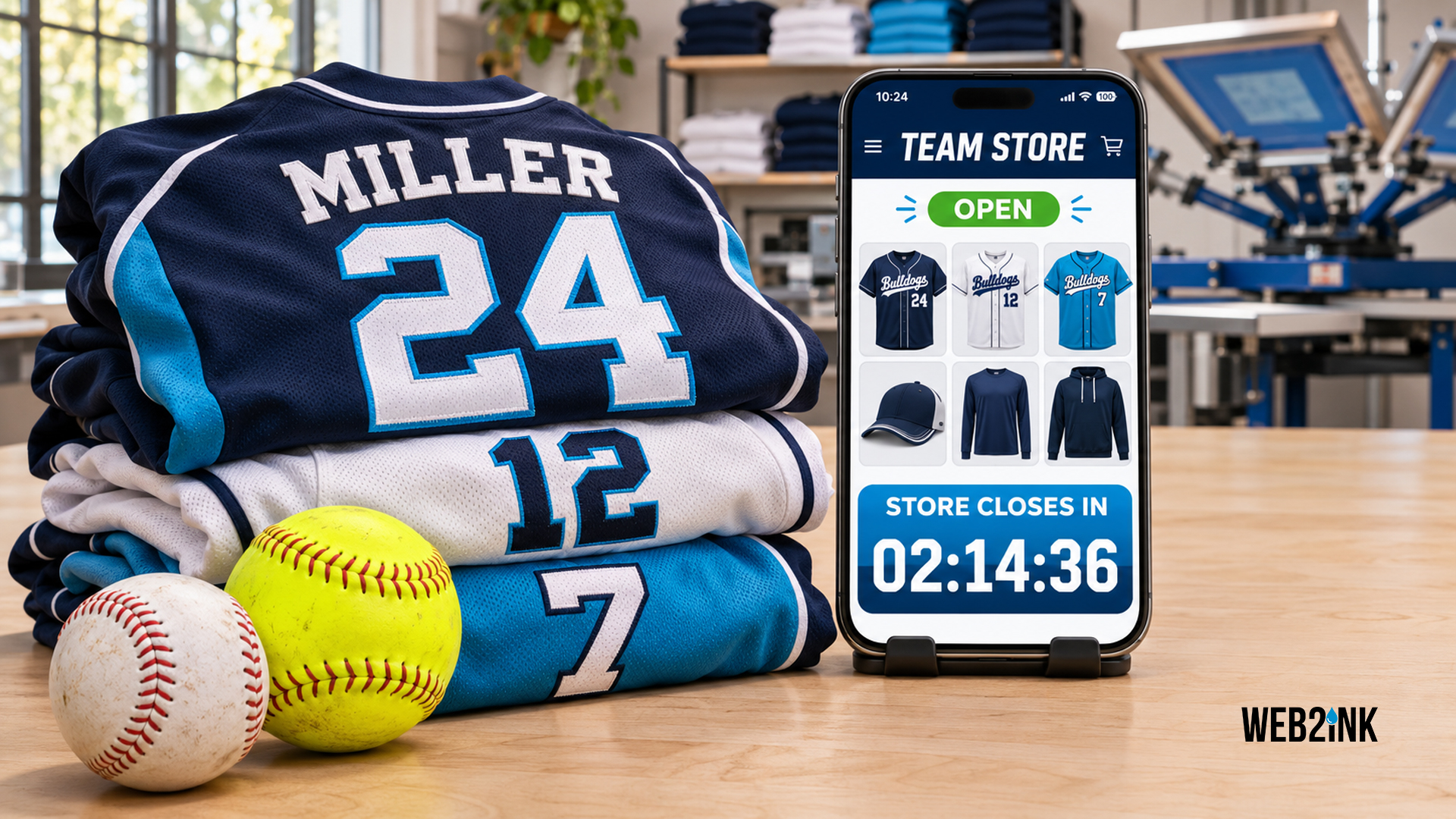
What’s the best way to run team stores for spring sports?
Spring sports orders feel like they show up all at once in February. But they do not. In fact, the shops that win them set up their team stores in December and January. Here is the playbook: timing, software, pricing and the details that keep a team store profitable.
The best way to run spring team stores is one time-boxed online store per team: open 10 to 14 days, names and numbers collected at checkout, one batch production run after close. So set them up in December and January. Also watch per-order fees: 3.5% on $30,000 of team store sales is $1,050 you could keep with a flat-fee platform.
Updated November 2026 · By Steve, print shop owner and founder of Web2Ink
Why should spring team stores be built in December and January?
Because the calendar works backward from the first game. In many states, spring sports like baseball, softball, track, lacrosse and soccer start practice in February or March. Coaches want players in matching gear before opening day. Then work back from that date:
Dec
Jan
Feb
Mar
Contact coaches, get rosters, build stores
Stores open 10 to 14 days each
Batch production, 2 to 3 weeks after each close
Sorted delivery to coaches before first games
December has another advantage. That is when coaches and booster clubs are planning budgets and fundraisers. If your shop is the one that shows up with a ready-to-open store, you get the order before anyone else quotes it. The same rhythm then repeats for fall sports in June and July.
What should team store software actually do?
A team store is not just a web page with shirts on it. Instead, it is a small, timed fundraiser that has to produce clean production data. Look for these:
- Open and close dates. A deadline creates urgency for parents and also gives you one batch to produce.
- Names and numbers at checkout. Personalization fields per item, priced as an add-on, captured with the order.
- Mobile ordering. Most parents will order from a phone, often while sitting in the bleachers.
- Fundraising or profit sharing. A set amount per item goes back to the team or booster club, tracked automatically.
- Self-management. The coach or booster parent can set up and run the store, so you do not have to build every one.
- Production reports. Totals by product, color and size, as well as a name and number list sorted by player.
- Bulk delivery. Ship or deliver everything to the coach, sorted, instead of 60 single packages.
- No surprise fees. Know before you sign whether you pay per month, per store or per order.
How much does team store software cost?
Here is what the common options charge, from vendor pricing pages as of November 2026. Check each vendor’s site before you sign.
| Platform | Monthly | Up front | Per-order fee | Notes |
|---|---|---|---|---|
| Web2Ink Pro | $299 | $2,500 setup | None | Full custom website; customer-managed stores with profit sharing and payouts |
| Chipply | $0 | $1,000 onboarding | 3.5% + card fees | Low fixed cost; fee grows with sales |
| OrderMyGear | $119 to $199 store hosting | $1,899 to $2,999 license | 3.95% of cart on pop-up stores | Built for stores; now shares a parent with InkSoft |
| DecoNetwork Premium | $339 | One-time license, not published | None listed | Team sports and fundraiser stores start at Premium |
| InkSoft | About $314 (Growth) to $419 (Bundle) | License, about $999 on promo | None listed | Power-ups extra |
When does a per-order fee cost more than a flat plan?
Divide the monthly fee by the percentage. For example, at 3.5%, a $299 monthly plan breaks even at $299 ÷ 0.035 = $8,543 a month in store sales. At 3.95%, it breaks even at $7,570 a month. Below that, the percentage platform is cheaper, but above it, the flat plan wins.
Be honest with yourself about your volume. If you run four team stores a year and nothing else online, then Chipply’s $0 a month is hard to beat. But if team stores are one part of a year-round online business, including company stores, reorders and a website that brings in new customers, a flat plan with no sales fee usually wins. Card processing fees apply on every platform, so leave them out of the comparison.
What does one profitable team store look like?
Here is a worked example for one high school softball team. The costs are example numbers for blanks plus decoration, so plug in your own.
| Item | Units sold | Your cost each | Store price | To boosters each | Your margin each |
|---|---|---|---|---|---|
| Practice tee | 40 | $7.50 | $22 | $3 | $11.50 |
| Hoodie | 25 | $18.00 | $45 | $5 | $22.00 |
| Team cap | 15 | $9.00 | $28 | $3 | $16.00 |
| Name and number add-on | 30 | $2.00 | $8 | $0 | $6.00 |
| Total | 110 | $945 | $2,665 sales | $290 | $1,430 |
That one store brings in $2,665 in sales and $1,430 in gross margin before card fees, and gives the boosters $290 to talk about at the next meeting. By comparison, a 3.5% per-order fee on this store would be about $93. Now run 12 stores like it in a season: $31,980 in sales, $17,160 in margin, and about $1,119 in per-order fees on a percentage platform.
Notice where the margin comes from. In particular, the hoodie and the name and number add-on do a lot of the work. Personalization costs little to produce, but parents happily pay for it. DTF transfers are a common way to apply names and numbers; our DTF overview explains the process.
How do I set up a team store, step by step?
- Get the roster early. Ask the coach for player names, numbers and the first game date. Then confirm team colors and logo files.
- Fix the art before the store opens. A blurry logo becomes 110 blurry products. For that reason, vectorize it first. An image vectorizer does it in seconds.
- Pick 4 to 6 products. For example, a tee, a hoodie, a cap and one or two extras. Too many choices slow parents down and split your batch into tiny runs.
- Set prices with the booster share built in. Decide the per-item amount for the team and show it on the store so parents know their purchase helps.
- Set open and close dates. 10 to 14 days works well. Also, put the close date at the top of the store.
- Send one link through the coach. After all, parents know the coach. A message from the coach carries more weight than an email from a shop they have never heard of.
- Remind twice. Once at the halfway point and once 48 hours before close.
- Close, batch and produce. Pull totals by size and a sorted name and number list, then produce everything in one run.
- Deliver sorted by player. Bag each order with the player’s name on it and deliver to the coach in one drop.
Should I run self-managed or shop-managed team stores?
Best for shops with many small teams: self-managed stores. The booster parent or coach creates the store from your approved products, sets the dates and shares the link. You only step in when it is time for production. That is how you run 30 stores in a season without 30 evenings of setup.
Best for big programs and first-time customers: shop-managed stores. Build the first store yourself so it is right, then hand over the keys for the next season.
On Web2Ink, clients, companies and teams can create and manage their own stores, with profit sharing built in and no percentage fee on store sales. Guardrails still matter. Limit self-managed stores to products and prices you have approved, so nobody sells a $12 hoodie by accident.
How do I handle names and numbers without mistakes?
Names and numbers are where team orders go wrong. They are also where the margin is. Xander at Customtshirts4u has told us he likes the name and number personalization for his sports apparel orders. A few rules keep it clean:
- Collect names and numbers in the store at checkout, not on a paper list later.
- Ask the coach to confirm the number list against the roster before you print. Two players with the same number is a common mistake that is easy to catch here.
- Decide on capitals, spacing and maximum letters before the store opens. Long last names need a plan.
- Before you print, send a final name and number proof to the coach. One email now saves a reprint later.
- Print the list sorted by player, then by product, so bagging is fast.
Which decoration method fits each team store item?
- Screen printing: the same front design on many tees and hoodies. See Web2Ink for screen printers.
- DTF or heat-applied vinyl: names, numbers and short runs of extra colors.
- Embroidery: caps, polos for coaches and bags.
- Sublimation: full-color jerseys and shooters on polyester.
See how Web2Ink sites are set up for screen printers, embroidery companies and sublimation printers.
What mistakes kill team store profit?
- Leaving the store open. Once the batch is done, late orders become one-off production runs that cost you money.
- Shipping to every family. Postage on 60 small packages can eat a big piece of the margin, so deliver in bulk.
- No size chart. Because youth and adult sizing confuses parents, post a chart for every product and expect fewer exchanges.
- Starting in February. By then, the coach has often already said yes to someone else.
- Paying fees you did not price in. Know your platform’s per-order cost and build it into the store price before you open.
Running holiday or corporate stores too? Web2Ink’s custom stores use the same setup for businesses.
Get your spring team stores ready in December
Launch stores coaches can run themselves, with names and numbers, profit sharing and no per-order fees. Most Web2Ink sites launch 5 to 7 business days after onboarding.
Frequently asked questions
What is the best team store software for a print shop?
It depends on your volume. A flat-fee platform with no per-order fee, such as Web2Ink, suits shops running many stores alongside a year-round website. On the other hand, a percentage platform such as Chipply suits shops running only a few stores a year.
When should I set up spring sports team stores?
Set them up in December and January. Spring seasons in many states start in February or March, and you need 10 to 14 days of selling plus 2 to 3 weeks of production before the first game.
What is a self managed team store?
It is a team store the coach or booster club creates and runs from your approved products and prices. They set the dates and share the link, while your shop handles production. As a result, you can run many stores without building each one.
How long should a team store stay open?
About 10 to 14 days works well for most teams. That is long enough for families to order, but short enough to create urgency and give you a single production batch.
How do team store fundraisers work?
A set amount from each item sold goes back to the team or booster club. In the worked example here, for instance, $3 to $5 per item raised $290 on a $2,665 store. Show the amount on the store so parents know their order helps.
Are per-order fees on team store platforms worth it?
They are cheap at low volume but expensive at high volume. Specifically, at 3.5%, a $299 monthly plan with no sales fee breaks even at about $8,543 a month in store sales. Above that point, though, the flat plan costs less.
About Web2Ink: A web-to-print platform and custom website for screen printers, embroiderers, DTF and sign shops, with an online designer, instant quoting and company stores. From $79/mo. Based in Charlotte, North Carolina.
Web2Ink supports third-party integrations and can also provide custom development for workflows that require a specialized connection. The exact integration scope should be confirmed during discovery.
popular articles
Share this article
Build a better print shop website.
Get a modern, high-performing website designed for print businesses.
RELATED ARTICLES
Keep learning. Keep growing.
More practical ideas to help you run a stronger, more successful print shop.
Put these ideas to work for your shop.
See how Web2Ink can help you sell more print online and grow your business.
