

7 Best InkSoft Alternatives in 2027 (After the Inktavo–OrderMyGear Merger)
Seven InkSoft alternatives for print shops, priced side by side, with a year-one cost example and an honest drawback for each.
What’s a good alternative to InkSoft?
In October 2025, Inktavo, the company that owns InkSoft, Printavo and GraphicsFlow, merged with OrderMyGear. So if you run InkSoft today, that news probably made you ask what else is out there. Here are seven real options, priced and judged the way a shop owner would judge them.
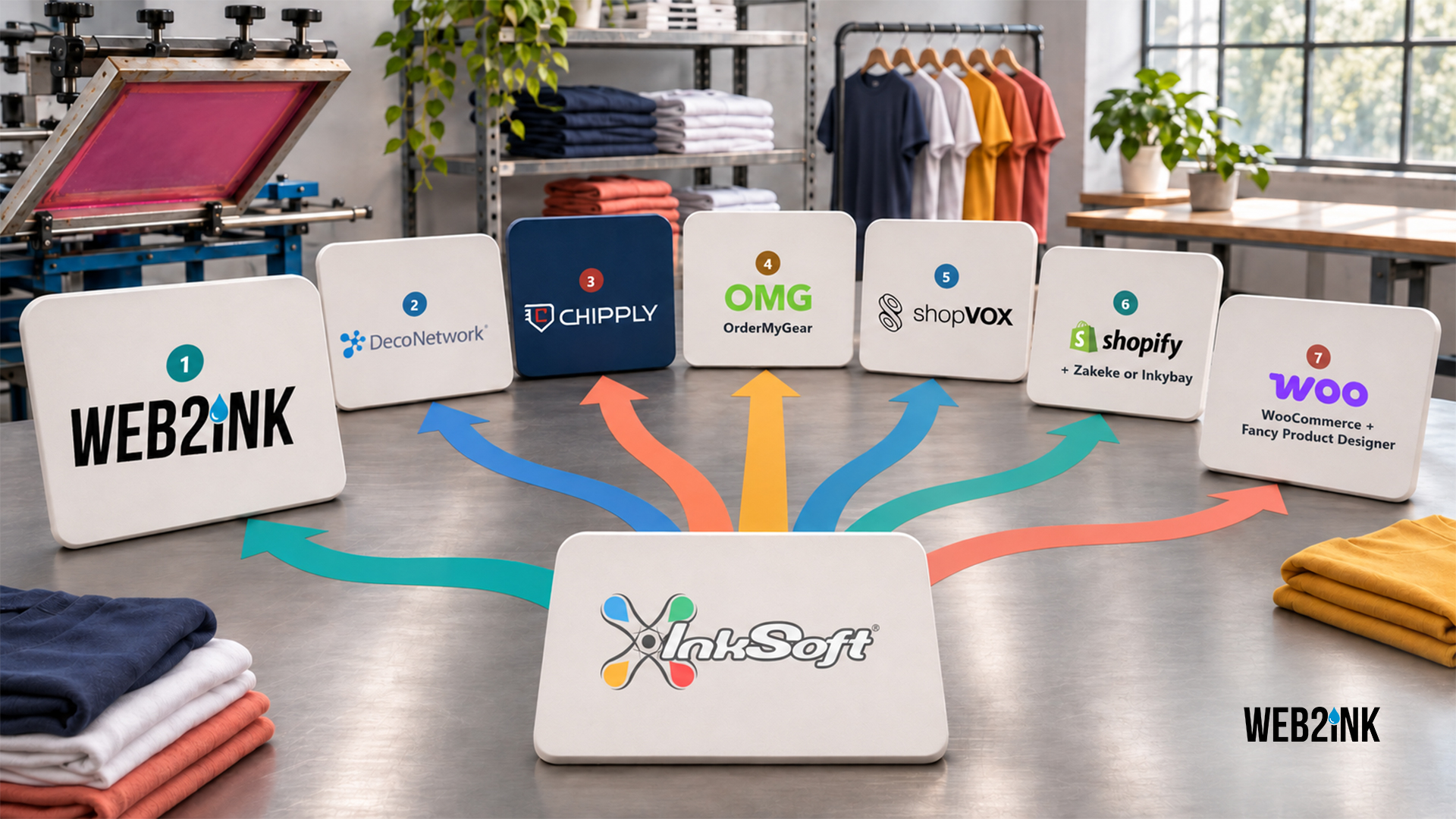
The best InkSoft alternative depends on what you need most. For a custom website you own, with a designer, instant quotes and company stores, Web2Ink starts at $199/mo with no sales fee. If you need deep production management instead, pick DecoNetwork. For no monthly bill, Chipply. Finally, for the cheapest start, Shopify plus a customizer app.
Updated November 2026 · By Steve, print shop owner and founder of Web2Ink
Why are print shops looking for InkSoft alternatives in 2027?
- Ownership changed. Inktavo is private equity backed, and after the OrderMyGear merger it now owns InkSoft, Printavo, GraphicsFlow and OrderMyGear. As a result, some owners worry about less competition and future price changes.
- Price. As of November 2026, InkSoft’s Growth plan runs about $314/mo and the Bundle about $419/mo, plus a one-time license (about $999 on promo, with an implied list near $1,999). Power-ups like Jobs ($99) and White Label ($49) also cost extra. On top of that, reviews mention price increases.
- The website. Reviews also mention a limited website builder. That matters when your site is how new customers find you on Google.
Still, to be fair, InkSoft has real strengths. Its online designer is mature, it has a large decorator community, and it connects to Printavo for shop management. So if it works and the price fits, you don’t have to switch.
How did we pick and rank these alternatives?
Full disclosure first: I founded Web2Ink, so it’s on this list and it’s listed first. That is why I’ve tried to judge it by the same rules as everyone else and to give it an honest drawback too. Read all seven before you decide.
To start with, every option was scored on six things a print shop actually needs from an online store:
- Do you get a real website that ranks on Google, or just a storefront?
- Is there an online designer your customers can use on a phone?
- Can it price decorated products (quantity breaks, print locations, setup fees)?
- Can you run team, company and spirit stores?
- How deep is production and order management?
- Is the pricing published, and does it take a cut of your sales?
Prices below come from vendor pricing pages as of November 2026. They change often, so check the vendor site before you sign anything.
What are the 7 best InkSoft alternatives?
1. Web2Ink
Best for: shops that want a custom-designed website they control, with web-to-print built in, and no percentage fee on store sales.
Price (as of November 2026, check vendor site): Catalog $79/mo + $499 setup. Basic $199/mo + $1,500 setup. Pro $299/mo + $2,500 setup. Hosting is also included, with no long-term contract and a 30-day money-back guarantee.
Web2Ink is built on WordPress and WooCommerce, and every site is custom designed rather than a template. In addition to the custom site, you get an online product designer that works on mobile, team orders with names and numbers, an instant price quoter (quantity tiers, print locations, setup charges, shown right on the product page), and client, company and team stores your customers can create and manage themselves, with profit sharing. Pro also adds an AI design studio, and the platform includes an image vectorizer and upscaler for blurry customer logos. Besides that, you control your SEO titles, meta and structured data, and there’s a blog. Once onboarding is done, most sites launch in 5 to 7 business days. Development, hosting and support are in the USA.
Honest drawback: the order manager handles art files, due dates, custom production statuses and automatic emails, but it is not a full shop management system. If you need deep scheduling, purchasing and production boards, DecoNetwork or Printavo goes further.
2. DecoNetwork
Best for: shops that want one all-in-one system for production management, online stores and the designer.
Price (as of November 2026, check vendor site): Standard $239/mo, Premium $339/mo, Enterprise $439/mo, plus a one-time license whose amount is not published.
Unlike most storefront tools, DecoNetwork’s strength is production. Job scheduling, purchasing and order workflow are deeper than what most storefront tools offer, including Web2Ink’s. If your back office is the bigger headache than your website, this is a serious option.
Honest drawback: reviews mention the price more than doubling and a dated designer interface. The unpublished license fee also makes it hard to know your true year-one cost until you talk to sales.
3. Chipply
Best for: shops running mostly team and spirit stores that want no monthly bill.
Price (as of November 2026, check vendor site): $0/mo, $1,000 onboarding, then 3.5% plus card fees per order.
You pay only when you sell. For a few team stores a season, fixed costs stay at zero, so the fee can be built into store prices.
Honest drawback: the percentage keeps growing as long as your sales grow. At $200,000 a year in online sales, 3.5% is $7,000 before card fees. It’s also store focused, so you still need a separate website for your shop.
4. OrderMyGear
Best for: shops and distributors whose business is mainly company stores and large pop-up stores.
Price (as of November 2026, check vendor site): company store hosting $119 to $199/mo, licenses $1,899 to $2,999, pop-up stores 3.95% of cart.
Honest drawback: since October 2025 it belongs to the same parent company as InkSoft. So if your reason for leaving is the vendor, this isn’t really leaving. The 3.95% pop-up fee also adds up on big stores.
5. shopVOX
Best for: sign shops and mixed shops that want quoting, job management and an online store from one vendor.
Price (as of November 2026, check vendor site): $109 to $249/mo plus per-user fees. On top of that, the e-commerce add-on is $199/mo per 100 orders.
shopVOX is strong on quoting and job tracking, especially for signs and graphics, where every job is a little different.
Honest drawback: per-user fees and the per-100-orders e-commerce pricing make costs climb when you add staff and web volume. In other words, it is shop software first and a storefront second.
6. Shopify plus a customizer app (Zakeke or Inkybay)
Best for: new or very small shops that want the cheapest possible start and are comfortable setting things up themselves.
Price (as of November 2026, check vendor site): Shopify $39, $105 or $399/mo, plus a customizer app. For example, Zakeke runs $69.90 to $299.90/mo, Inkybay $19.99 to $249.99/mo.
Shopify is reliable and you can be selling custom tees this weekend for under $60 a month.
Honest drawback: you build it yourself. Also, decorated-product pricing (setup fees, per-location charges, quantity breaks across sizes) is limited in most apps, and team stores usually need more apps stacked on top.
7. WooCommerce plus Fancy Product Designer
Best for: shops with someone technical in-house who wants full control and the lowest software bill.
Price (as of November 2026, check vendor site): Fancy Product Designer from a $59 license, plus your own hosting and maintenance.
WooCommerce is free, open source and you own everything. In fact, it’s the same base Web2Ink is built on.
Honest drawback: you are the developer, the host and the support desk. Print pricing, stores and order workflow all need extra plugins or custom work, while updates are on you.
What about Printavo? Printavo is shop management rather than a storefront, and it’s owned by the same parent as InkSoft. It does sell a Merch stores add-on, but its own blog points shops to Squarespace or Wix for a marketing site. It pairs well with a storefront, but it doesn’t replace InkSoft on its own.
What does each InkSoft alternative cost in year one?
Monthly price alone hides the real cost, because one-time fees and sales fees add up. For example, take a shop doing $60,000 a year in online orders, using the entry plan that includes an online designer. Card processing fees apply to everyone and are left out unless noted.
| Platform | Monthly | One-time | Sales fee | Year one at $60K online sales |
|---|---|---|---|---|
| InkSoft Growth (for reference) | ~$314 | ~$999 promo license | None advertised | ~$4,767 (or ~$5,767 at list license) |
| Web2Ink Basic | $199 | $1,500 setup | None | $3,888 |
| DecoNetwork Standard | $239 | License, not published | None advertised | $2,868 + license |
| Chipply | $0 | $1,000 onboarding | 3.5% + card fees | $3,100 + card fees |
| OrderMyGear (low tier) | $119 | $1,899 license | 3.95% on pop-up stores | $3,327 (more if you run pop-ups) |
| shopVOX + e-commerce | $109 + $199 | None listed | None; add-on is per 100 orders/mo | $3,696 + per-user fees |
| Shopify Basic + app | $39 + $20 to $300 | None | Card fees | $708 to $4,068 |
| WooCommerce + FPD | Hosting | $59 license | Card fees | $59 + hosting + your time |
The math for Web2Ink Basic is $199 x 12 = $2,388, plus the $1,500 setup, for $3,888. For Chipply it’s 3.5% of $60,000 = $2,100, plus the $1,000 onboarding. After that, year two drops the one-time costs.
Year-one software cost at $60K vs $200K online sales
Web2Ink Basic: $3,888 at $60K, $3,888 at $200K
InkSoft Growth (promo license): $4,767 at both
Chipply (3.5% + $1,000): $3,100 at $60K, $8,000 at $200K
OrderMyGear pop-ups only (3.95% + $1,428 + $1,899): $5,697 at $60K, $11,227 at $200K
Blue = $60K a year · Black = $200K a year. Card fees excluded.
How do percentage fees change as your online sales grow?
Then take the same shop at $200,000 a year in online sales:
- Chipply: 3.5% of $200,000 = $7,000, plus $1,000 onboarding = $8,000 in year one, plus card fees.
- OrderMyGear, if all of it ran through pop-up stores: 3.95% = $7,900, plus $1,428 hosting and a $1,899 license = $11,227.
- Web2Ink Basic: still $3,888, because there’s no percentage fee on store sales.
Even so, fee-based pricing is not a bad deal for everyone. If you run three small team stores a year for $8,000 total, Chipply costs you $1,280 in year one and $280 after that. That’s cheaper than any monthly plan. In the end, the break-even point is what you need to find. For Chipply versus Web2Ink Basic in year two, it’s about $68,000 a year in online sales ($2,388 divided by 3.5%). Below that, the fee model wins, but above it, flat pricing wins.
Which InkSoft alternative fits which kind of shop?
- You want customers to find you on Google and order online: Web2Ink. See how it works for screen printers and embroidery companies.
- Your back office is the problem, not your website: DecoNetwork, or Printavo paired with a storefront.
- You mainly run seasonal team stores and want no fixed cost: Chipply.
- You’re a promo distributor with big corporate programs: OrderMyGear, knowing it shares a parent with InkSoft. Web2Ink also has a page for print brokers and distributors.
- You’re a sign shop with custom quotes on every job: shopVOX, or Web2Ink’s sign shop sites if you want the website to do more of the selling.
- You’re just starting and money is tight: Shopify plus Inkybay or Zakeke.
- You have a developer on staff: WooCommerce plus Fancy Product Designer.
For a deeper side-by-side, see how Web2Ink compares with InkSoft and DecoNetwork and the full list of Web2Ink features.
How do you switch from InkSoft without losing orders?
Here’s the order I’d do it in.
- Pick your timing. For example, spring sports team stores get set up in December and January. If you run them, switch before December or wait until they close. Above all, don’t move in the middle of a store.
- Export what you own. Pull your customer list, order history, product list and every piece of customer artwork you have.
- List your live stores. Note each active store’s contact, close date and products so that nothing gets dropped.
- Map your URLs. If your current site ranks on Google, list your top pages and set up 301 redirects from the old addresses to the new ones. This protects the traffic you’ve built so far.
- Tell your repeat customers. Send one short email with the new link and how to reorder. Store organizers, however, need a personal heads-up.
- Check the cancel terms. Read your current contract for notice periods before you give notice.
Whichever vendor you pick, ask them who does the migration work and how long it takes. On Web2Ink, for instance, most sites launch 5 to 7 business days after onboarding.
See if Web2Ink fits your shop
Take a walk through the designer, quoter and company stores, then compare plans. There’s no long-term contract, and you also get a 30-day money-back guarantee.
Frequently asked questions
What is the best InkSoft alternative for a print shop?
It depends on your main need. For example, Web2Ink fits shops that want a custom website with a designer, instant quotes and company stores and no sales fee. DecoNetwork fits shops that need deeper production management, while Chipply fits shops that want no monthly bill.
How much does InkSoft cost in 2027?
As of November 2026, InkSoft Growth is about $314/mo and the Bundle about $419/mo, plus a one-time license of about $999 on promo. Power-ups such as Jobs ($99) and White Label ($49) cost extra. Prices change, so check the InkSoft pricing page for current figures.
Is OrderMyGear a real alternative to InkSoft?
It is a different product, but since October 2025 it shares a parent company with InkSoft through the Inktavo merger. So if you want to leave the vendor, not just the product, OrderMyGear does not do that.
Is there an InkSoft alternative with no monthly fee?
Chipply charges $0/mo with $1,000 onboarding and 3.5% plus card fees per order. That suits low volume, since you pay only when you sell. Around $68,000 a year in online sales, the percentage starts costing more than a flat plan like Web2Ink Basic.
Can I keep my Google rankings if I switch from InkSoft?
Usually, yes, if you set up 301 redirects from your old page addresses to the new ones and keep your page titles and content. List your top pages before the move and test the redirects after launch.
Does Web2Ink replace Printavo or DecoNetwork for production?
Not fully. Web2Ink’s order manager covers art files, due dates, custom production statuses and automatic emails. So shops that need deep scheduling and purchasing often keep a dedicated shop management tool alongside it.
About Web2Ink: Web-to-print platform and custom websites for screen printers, embroiderers, DTF and sign shops, with an online designer, instant quoting and company stores. From $79/mo. Based in Charlotte, North Carolina.
Web2Ink supports third-party integrations and can also provide custom development for workflows that require a specialized connection. The exact integration scope should be confirmed during discovery.
popular articles
Share this article
Build a better print shop website.
Get a modern, high-performing website designed for print businesses.
RELATED ARTICLES
Keep learning. Keep growing.
More practical ideas to help you run a stronger, more successful print shop.
Put these ideas to work for your shop.
See how Web2Ink can help you sell more print online and grow your business.
